Which Paradise Is Yours? Find the Landscape That Matches How You Paint and Who You Are
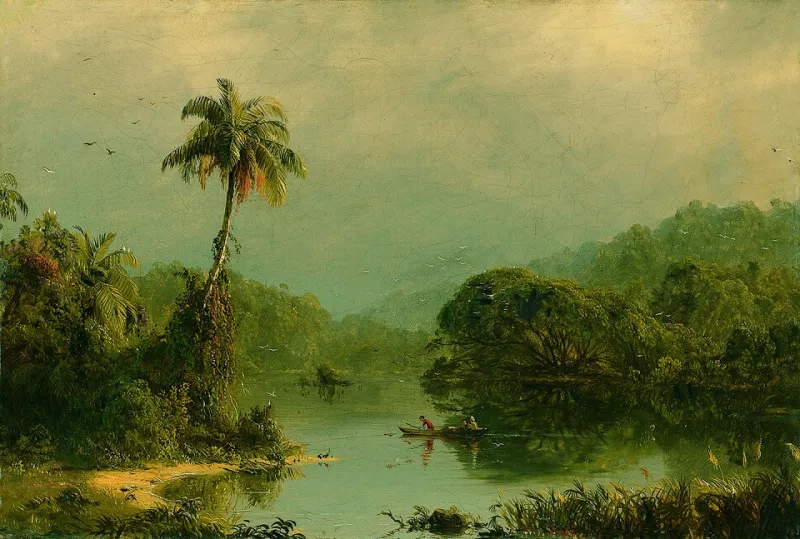
Photo: Frederic Edwin Church, Public domain, via Wikimedia Commons
Here's something worth thinking about: when you close your eyes and picture paradise, what shows up?
For some people it's a white-sand beach with that particular shade of blue-green water that doesn't quite exist anywhere else. For others it's a canyon bathed in amber light at sunset, or a fog-draped mountain range, or a jungle so dense and green it looks almost unreal. Whatever your instinct is, it matters—because the landscapes that pull at us emotionally tend to be the ones we paint most powerfully.
At Paint Me Paradise, we talk a lot about paradise as a feeling. But feelings have flavors. And the four major paradise aesthetics—tropical, coastal, desert, and mountain—each carry their own emotional signature, their own color logic, and their own set of techniques that make them come alive on canvas.
Let's break them down. See which one sounds like you.
The Tropical Artist: Bold, Layered, and Alive
Who you are: You love abundance. You're the person who fills a room with plants, who orders the most colorful thing on the menu, who finds beauty in the complicated and the lush. You're not afraid of a busy composition, and you probably have strong opinions about green—because there are approximately one thousand different greens and you know most of them.
What draws you to this aesthetic: Tropical landscapes are defined by layering. There's always something in front of something else, light filtering through canopy, color stacked on color. For painters, this is both the challenge and the thrill. Rainforests, jungle clearings, hibiscus-heavy gardens, bird-of-paradise blooms against dark foliage—these subjects reward patience and reward the artist who isn't afraid to go back in with more detail.
Color palette to explore: Viridian, sap green, cadmium yellow, coral, magenta, raw umber for shadow depth. Tropical paintings often fail when artists go too bright across the board—the secret is contrast. Deep, almost-black shadows make those saturated greens and pinks sing.
Techniques worth mastering: Wet-on-wet blending for foliage backgrounds, dry brush for texture on leaves and bark, and learning to suggest detail rather than render every leaf individually. Study how light behaves when it's filtered—it's softer, more diffused, full of reflected color from surrounding vegetation.
Community artist spotlight: Priya from Houston paints tropical botanicals in acrylic, focusing on close-up compositions of single blooms against shadowy backgrounds. Her work captures the hothouse intensity of tropical flora without feeling chaotic—a balance she says took time to find. "I used to paint everything the same brightness," she told us. "Learning to go dark in the shadows changed everything."
The Coastal Artist: Calm, Expansive, and Light-Obsessed
Who you are: You're drawn to open space. You breathe easier near water. You notice how light changes throughout the day and find yourself more affected by weather than most people around you. You're probably a patient painter—someone who can sit with a piece for a while before making a move.
What draws you to this aesthetic: Coastal landscapes are fundamentally about atmosphere. The relationship between sky and water, the way light hits a wave, the subtle gradations of sand from wet to dry—these are subjects that reward observation. Coastal painting isn't about dramatic complexity; it's about capturing something fleeting and making it stay.
Color palette to explore: Cerulean, ultramarine, titanium white, Naples yellow, raw sienna, and a touch of viridian for where shallow water goes green over sand. Coastal palettes are often deceptively simple—the sophistication comes from how you mix and layer, not from how many colors you use.
Techniques worth mastering: Soft blending for sky gradients, creating the illusion of water movement with horizontal brushstrokes of varying pressure, and painting foam and sea spray (hint: it's more about what you leave out than what you put in). Understanding aerial perspective is essential—distant water and sky merge in ways that require careful value control.
Community artist spotlight: Derek from the Outer Banks in North Carolina paints coastal scenes almost exclusively in oils, working from plein air sketches he makes at dawn. His paintings have that rare quality of feeling like a specific time of day. "The light at 6 a.m. over the water is different from 7 a.m. in ways most people don't notice," he says. "Painting taught me to notice."
The Desert Artist: Minimal, Dramatic, and Quietly Radical
Who you are: You find beauty in reduction. While other artists are adding, you're subtracting—editing down to the essential. You're probably someone who appreciates silence, who finds crowded spaces exhausting, and who has a deep appreciation for things that are understated but precise. You might be the person in your friend group who has impeccable taste and few words.
What draws you to this aesthetic: Desert landscapes are built on what isn't there. Wide open sky. Spare, sculptural plant life. Rock formations that look like they were designed. The drama in desert painting comes from light and shadow at their most extreme—harsh midday sun that bleaches color, or golden hour that turns everything to fire. These are paintings that can feel almost meditative to make.
Color palette to explore: Yellow ochre, burnt sienna, raw umber, cadmium orange, dusty rose, warm grays, and the unexpected purples that appear in desert shadows. Desert painting surprises people with its color range—it's not just brown. There's lavender in the shadow of a boulder. There's almost-pink in the sky before sunrise.
Techniques worth mastering: Hard edges for rock formations, soft edges for sky and distant landscape, and learning to paint heat haze and atmospheric shimmer. Negative space is your friend. Resist the urge to fill every inch of canvas—the empty parts of a desert painting are as important as the painted parts.
Community artist spotlight: Claudia from Tucson paints desert scenes in gouache, a medium she says suits the desert's graphic quality. Her saguaro studies—single cacti against vast gradient skies—have become a signature style. "Desert painting taught me to trust simplicity," she says. "That's hard to learn and easy to love once you get there."
The Mountain Artist: Structural, Moody, and Built for Scale
Who you are: You think in terms of structure. You like paintings that have weight and permanence. You're probably someone who is drawn to challenge—both in life and on canvas—and who finds something deeply satisfying about tackling a subject that's genuinely hard to get right. You might be the most technically ambitious of the four paradise types.
What draws you to this aesthetic: Mountains are about form and atmosphere in conversation. Getting the geology right—the way ridgelines stack, the logic of how snow sits on a slope—matters. But so does capturing the emotional scale of these landscapes, the feeling of smallness that comes from standing at the base of something enormous. Mountain paintings often take longer. They reward the long game.
Color palette to explore: Payne's gray, ultramarine blue, burnt umber, titanium white, and the surprising warmth of reflected light on snow (which is almost never pure white). Mountain palettes tend to be cooler and more muted than the other paradise types, with drama coming from value contrast rather than color saturation.
Techniques worth mastering: Layering to create depth across multiple mountain planes, wet-on-dry for crisp ridgelines, and understanding how atmospheric perspective works at altitude (distant peaks go bluer and lighter, edges soften). Snow is a particular skill—learning to paint it with color rather than just white is a turning point for most mountain painters.
Community artist spotlight: Ben from outside Denver paints mountain landscapes in watercolor, which he says forces him to commit to decisions in a way that oil painting doesn't. His work captures the particular quality of Rocky Mountain light—clear and cold and high. "Mountains have a logic to them," he told us. "Once you understand it, every painting gets a little more honest."
So, Which One Is You?
Maybe you read through all four and felt a pull toward one immediately. Or maybe you're a coastal-desert hybrid, someone who loves open space but craves warmth. That's real too—plenty of artists work across multiple paradise aesthetics and find that each one teaches them something different.
The point isn't to lock yourself into a category. It's to give yourself a starting point. Paradise is personal. Your version of it is worth painting.
We'd love to see which direction you go. Share your work in the Paint Me Paradise community and tag which paradise you're painting. Your paradise is out there. Go find it on canvas.