After the Tourists Leave: Why Fall Is the Secret Season for Your Deepest Paradise Paintings
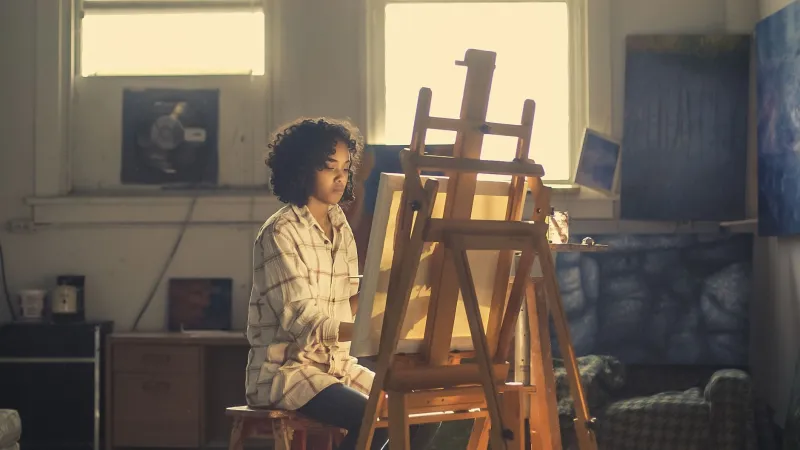
Somewhere around mid-September, a shift happens. The Instagram feeds full of beach selfies start thinning out. The flight deals to Cancún and Maui stop flooding your inbox. The collective cultural obsession with summer paradise — with sunscreen and tiki bars and golden-hour Instagram content — quietly powers down for another year.
For most people, that's a small sadness. For paradise painters, it's an invitation.
If you've ever felt like your tropical work gets flatter, more generic, or somehow less yours during the height of summer, you're not imagining it. There's a real psychological current running beneath the surface of your creative process, and understanding it might be the most useful thing you do for your art this year.
The Noise You Don't Realize Is Getting Inside Your Work
Summer is loud. Not just acoustically — visually, emotionally, and culturally loud. Paradise imagery is everywhere from June through August: travel ads, social media, magazine covers, home decor campaigns. Every coffee shop has a tropical playlist. Every retailer is pushing flamingo prints and palm leaf throw pillows.
That saturation gets inside your head whether you invite it or not.
When you sit down to paint a beach scene in July, you're not just working from your own imagination or reference photos. You're working through a thick fog of collective visual expectation. What a beach should look like. What turquoise should feel like. What paradise means to a culture that's been bombarded with it for three straight months.
The result? Paintings that feel weirdly familiar. Safe. Almost like you painted what everyone else expected you to paint, even when you were trying your hardest not to.
Fall strips that fog away.
What Happens to Your Eye When the Stimulation Drops
There's a concept in perceptual psychology sometimes called sensory recalibration — the idea that our senses sharpen when the input around them quiets down. You notice the sound of rain more clearly in a silent house than you do at a loud party.
The same thing happens visually when the summer paradise noise fades. Suddenly, your eye starts hunting for the details it was too overwhelmed to notice before. The specific way afternoon light turns slightly amber in October. The cooler undertones that creep into even the warmest color palettes. The way memory of a tropical place feels different when you're sitting in a gray Ohio afternoon than when you're standing in actual 90-degree humidity.
That distance — physical, seasonal, emotional — is one of the most underrated tools in a paradise painter's kit.
Memory vs. Observation: Fall Gives You Access to Both
Here's something working painters discover eventually: there are two fundamentally different ways to approach a paradise scene. You can paint what you're observing directly, or you can paint what you remember. Both have value, but they produce very different kinds of work.
Observation-based painting tends toward accuracy. Memory-based painting tends toward feeling.
Summer lends itself to observation — you might actually be at the beach, or surrounded by enough tropical visual stimulation that your paintings become almost documentary. Fall invites memory. And memory, interestingly, edits for meaning. Your brain doesn't remember every wave on a Florida coastline with equal weight. It remembers the ones that felt significant. The light that made you stop talking. The color that didn't match anything in your paint box.
Painting from that filtered memory produces work that carries emotional weight in ways that direct observation sometimes can't touch.
Try this: pull out a reference photo from a beach trip you took two or three summers ago — not last month, but far enough back that the details have softened. Paint from the photo, but also paint from what you feel when you look at it. Notice how differently your brush moves.
The Practical Case for Off-Season Studio Work
Beyond the psychology, there are genuinely practical reasons fall and winter are productive seasons for tropical-themed artists.
Your schedule opens up. Summer for a lot of American painters is fragmented — family trips, weekend plans, social obligations. Fall brings routine back. More consistent studio time means more consistent creative momentum, and momentum is everything when you're trying to push through a stylistic plateau.
Reference material gets cheaper. Planning a research trip to a tropical location? October through early December is shoulder season across most of the Caribbean, Hawaii, and coastal Mexico. Fewer crowds, lower prices, and — crucially — a different quality of light and atmosphere than the peak-summer version of those places. The tourists are gone, and what's left is something more raw and honest.
You're painting against the grain. There's a quiet creative energy that comes from working on something that runs counter to your immediate environment. Painting vivid coral and warm sand tones while rain streaks your studio window creates a productive tension. You're not just rendering a scene — you're reaching for it. That reaching shows up in the work.
How to Lean Into the Seasonal Shift Intentionally
If you want to actually use this seasonal transition rather than just survive it, a few approaches are worth trying.
Build a summer archive. Before summer fully ends, collect reference material deliberately — photos, color notes, texture sketches, written descriptions of specific light conditions. Think of it as stocking your creative pantry before the fresh produce runs out. You'll draw on this all fall and winter.
Start a memory series. Pick one place — a specific beach, a particular stretch of coastline, a backyard in the Keys — and commit to painting it monthly from September through February. Watch how your interpretation of that single place shifts as you move further from the sensory experience of summer and deeper into memory and imagination.
Pay attention to fall light. Don't dismiss the season you're actually in. October and November light in most of the US has a warmth and a quality that translates beautifully into tropical palettes when you're willing to observe it. The amber tones of a late-afternoon New England fall aren't so different from a Hawaiian sunset if you're paying attention.
The Painters Who Figured This Out
Some of the most iconic tropical and paradise-themed painters in American art history did their most important conceptual work away from the places they painted. Winslow Homer, whose Caribbean watercolors remain among the most emotionally direct tropical paintings in American art, spent the majority of his time in Maine. The distance wasn't a limitation — it was the source.
You don't have to be in paradise to paint it well. Sometimes the best thing you can do is let summer end, let the noise clear, and see what's left when it's just you, your brush, and the version of paradise that actually lives inside you.
That version? It's been waiting all summer for a little quiet.