The Moment You Stop Painting for Money Is the Moment Your Best Work Shows Up
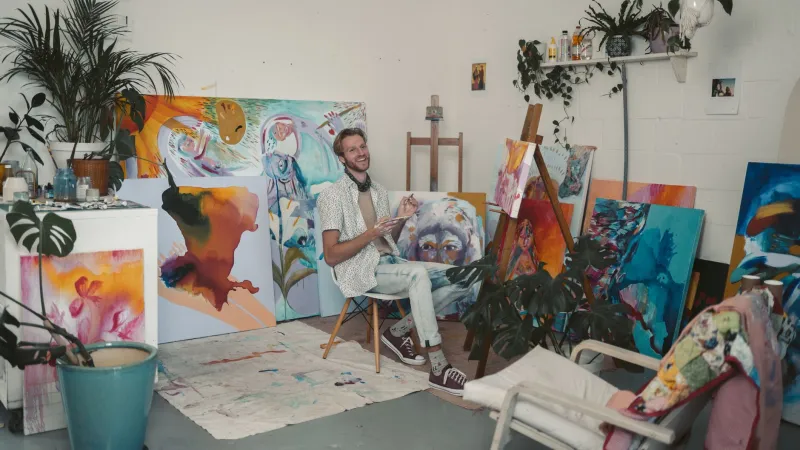
Ask any paradise painter to point to their favorite piece — the one they'd hang in their own living room, the one that still gives them a little flutter when they look at it — and there's a pretty good chance it wasn't made for anyone. No client waiting on it. No Etsy listing drafted. No Instagram caption half-written in the back of their mind while the paint was still wet.
It was just a Tuesday afternoon and a canvas and some leftover turquoise they didn't know what to do with.
This isn't a coincidence. It's one of the most consistent patterns in creative work, and it's worth slowing down to understand why it happens — because once you get it, you can actually use it.
The Sales Brain vs. The Painter Brain
When you're making work with a buyer in mind, your brain shifts modes. You start editing before you've even started. You think about what sold last month, what got the most comments, what the algorithm seemed to reward. You reach for the colors that feel "safe" — that warm coral sunset palette because it always moves — instead of the weird stormy teal you've been wanting to try.
None of this is conscious. It just happens. And the result is technically competent work that somehow feels hollow.
Psychologists call this phenomenon extrinsic motivation crowding out intrinsic motivation — basically, once there's an external reward attached to something, the internal joy of doing it tends to shrink. Artists experience this as a kind of creative stiffness. The brushwork gets careful. The compositions get predictable. The whole thing starts to feel like filling an order rather than making something.
Paradise painting is especially vulnerable to this trap because the subject matter is inherently appealing to a broad audience. Tropical scenes sell. Beaches move. Sunsets over the water are basically guaranteed to get engagement. So the commercial pull is strong, and it starts early.
What Happens in the Experimental Phase
Most painters who've been at it for a while can identify a specific window — usually before they made their first sale, or during a period when they'd stepped back from trying to sell — when something clicked. The work got looser. More personal. Weirder in the best way.
Take the story of a Florida-based painter named Dana (a composite based on experiences shared widely in art communities) who spent two years posting tropical watercolors that got polite engagement but never really caught fire. Then she took a month off from posting entirely, started painting just for herself, and came back with a series of moody, overcast Gulf Coast scenes that looked nothing like what she'd been doing. They sold out in a week.
What changed? She stopped performing paradise and started painting her actual experience of it — which included gray days and choppy water and the strange melancholy of an off-season beach town.
That authenticity is what people were responding to. Not the subject matter. Not the technical execution. The fact that it felt real.
The Authenticity Problem Is a Pressure Problem
Here's the uncomfortable truth: you probably already know what your most authentic work looks like. You've painted it. Maybe you didn't post it because it felt too weird or too personal or too far from your "brand." Maybe it's sitting in a stack somewhere, face down, because you weren't sure anyone would want it.
The pressure to be commercially viable doesn't just affect what you make — it affects what you allow yourself to keep. Artists routinely self-censor their most interesting work before it ever reaches an audience.
This is the trap. And getting out of it doesn't require abandoning the business side of things. It requires building a structure that protects your experimental work from commercial pressure.
Practical Ways to Keep the Freedom Alive
Designate "no sell" sessions. Carve out regular studio time — even just one session a week — where you've already decided in advance that nothing you make will be listed, posted, or shown to anyone. The work from these sessions is for you. This sounds simple, but the psychological effect is significant. When your brain knows there's no audience, it relaxes.
Separate your sketchbooks from your inventory. Keep a dedicated space — physical or digital — for experiments that live outside your commercial catalog. These aren't failed paintings. They're your R&D department. Some of your best future work will grow directly out of what happens in these pages.
Sell from a place of abundance, not scarcity. One of the biggest drivers of commercial anxiety is the feeling that every painting needs to perform. If you're producing enough work that some of it can just exist without needing to justify itself economically, the pressure on your commercial pieces actually goes down too.
Notice what you're avoiding. Pay attention to the ideas you keep dismissing as "too weird" or "too niche" or "not really paradise enough." Those are often exactly the ideas worth chasing. The instinct to dismiss them is usually the sales brain talking, not your actual creative judgment.
Give yourself a "bad painting" quota. Some artists swear by intentionally making work they know won't sell — ugly color combinations, bizarre compositions, subject matter that has no commercial appeal. It sounds counterproductive. What it actually does is remind you that painting doesn't require permission from the market to be worthwhile.
The Business Case for Not Thinking About Business
Here's the irony: the work that comes out of your most pressure-free sessions is often the work that builds the most durable audience. Because people can feel the difference between a painting that was made with genuine curiosity and one that was made to move units.
Art buyers in the US — especially the ones buying original work rather than prints — are increasingly sophisticated about this. They're not just buying a tropical scene. They're buying a point of view. A sensibility. The evidence that a real human being was genuinely engaged with what they were making.
You can't fake that. But you can protect the conditions that make it possible.
The paradise you're painting is more compelling when it comes from somewhere true. And that truth almost always shows up when you've stopped trying to sell it.
So the next time you sit down at your easel with nothing on the line and no one waiting — that's not wasted time. That might be the most important work you do all week.