Why Painting Less Gives You More: The Creative Power of Choosing One Paradise and Sticking With It
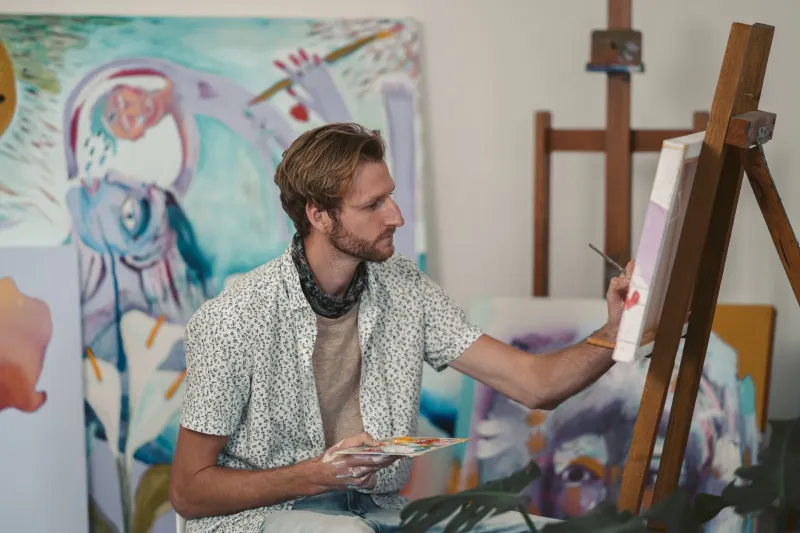
There's a moment most painters know well. You're standing in front of a blank canvas, every color on the wheel available to you, every technique in your back pocket, every tropical scene on the planet as a potential subject — and you freeze. Total creative paralysis. Too many choices, not enough direction.
Here's the counterintuitive fix: pick one thing and go deep.
Artists who've deliberately boxed themselves in — one location, one limited palette, one signature brushwork style — are producing some of the most compelling paradise-themed work happening in the US right now. And the psychological research behind why this works is genuinely fascinating.
The Paradox Nobody Talks About at the Art Store
When we think about creativity, we tend to imagine it as something that thrives in wide-open space. More colors, more reference photos, more techniques — more everything. But creative psychology tells a different story.
Barry Schwartz's well-known concept of the "paradox of choice" — the idea that too many options actually make us less satisfied and less decisive — applies directly to the studio. When you limit the variables, your brain stops spending energy on selection and starts spending it on expression. That's where the real painting happens.
For paradise artists specifically, this shows up in a really particular way. The genre is already visually rich — turquoise water, golden sand, lush canopy greens, sunset gradients. When everything is available, painters often reach for all of it at once. The result? Canvases that feel busy, generic, or like a greatest-hits reel of tropical clichés.
Constraint cuts through that noise.
One Beach, Infinite Paintings
Take the approach that self-taught Florida-based painter Marcus Delray has built his entire practice around. For the past four years, he's painted almost exclusively from reference photos and memories of one stretch of coastline near Islamorada in the Florida Keys. Same location, hundreds of paintings.
"People ask me if I get bored," he says. "It's the opposite. Every time I go back to that same shoreline, I see something I missed before. The way the light changes the water color in the afternoon versus early morning. The specific shape of the mangroves on the left side. I've been painting the same place for years and I feel like I'm just now starting to understand it."
What Delray describes is exactly what constraint is supposed to do. When you remove the question of where, you get to go much further with how. His Islamorada paintings have developed a texture and emotional specificity that's hard to manufacture any other way — because it wasn't manufactured. It was excavated, slowly, through repetition and restriction.
The Palette Limitation Experiment
For painters who aren't ready to commit to one location, limiting the color palette is often a gentler entry point into the same principle.
Colorado-based artist Jenna Whitmore spent a year working exclusively with four tubes of paint — a warm yellow, a deep cerulean, burnt sienna, and titanium white — to render tropical beach scenes she'd never actually visited. The restriction forced her to become a master of mixing and to develop a highly personal visual language for paradise that looked unlike anyone else's.
"I couldn't rely on buying a 'perfect turquoise' from the store," she explains. "I had to make turquoise, and my version of it became my signature. People started recognizing my work at shows before they even saw my name on the tag."
That recognition factor is no small thing. In a crowded market for tropical and coastal art — and it is genuinely crowded, especially online — a distinct visual identity is one of the most valuable assets a painter can build. Limitation, paradoxically, is one of the fastest routes to get there.
What Happens in Your Brain When You Work Within Walls
From a neuroscience angle, creative constraints work by forcing the brain's prefrontal cortex (the planning, decision-making region) to hand off more control to deeper, more intuitive processing. When your choices are narrowed, the analytical mind quiets down. You stop deciding and start painting.
Researchers at Johns Hopkins have studied jazz improvisation under similar conditions — musicians who were given restricted note sets actually produced more emotionally expressive music than those given full freedom. The parallel to visual art is pretty direct.
For painters dealing with anxiety, perfectionism, or creative blocks — which, honestly, describes most of us at some point — constraint also removes a huge source of pressure. You're not trying to paint all of paradise. You're painting this corner of it, this way. That's a much more manageable assignment for your nervous system.
How to Choose Your Constraint (Without Overthinking It)
The beauty of this approach is that there's no single right constraint. What matters is that it feels genuinely meaningful to you, not arbitrary.
A few entry points that work well for paradise painters:
Pick a place with personal history. A beach town you visited as a kid, the coast near where you grew up, even a destination you've only seen in photos but feel drawn to. Emotional connection deepens the work.
Limit your palette to three or four colors. Choose one warm, one cool, one neutral, and white. See how long you can stay in that world before you expand it. You might be surprised how long that is.
Commit to one technique for a full season. Palette knife only. Wet-on-wet only. Dry brush over textured ground. Give yourself three months and see what develops.
Set a size constraint. Painting exclusively small (6x6 or 8x10) forces a different kind of intimacy with the subject. Painting exclusively large forces a different kind of boldness. Either way, the boundary does something.
Limitation as a Long Game
Here's the thing that surprises most painters when they try this: the constraint doesn't feel like a cage after a while. It feels like a home.
When you've spent six months painting the same Gulf Coast horizon, or mixing the same tight palette of sunset colors, you stop seeing the limitation as something imposed on you. It becomes yours. It becomes the specific way you see paradise, and that specificity is what makes art resonate with the people who end up living with it on their walls.
Unlimited freedom sounds like the dream. But in practice, it often produces work that's technically accomplished and emotionally empty. The artists building the most interesting creative practices right now — the ones developing real followings, real voices, real staying power — are often the ones who made a deliberate choice to go narrow and go deep.
One beach. Four colors. A single style of mark-making. Your version of paradise, defined and refined until it couldn't belong to anyone else.
That's not a limitation. That's a practice.