Paint Worse to Paint Better: The Counterintuitive Secret Behind Every Artist's Breakthrough Moment
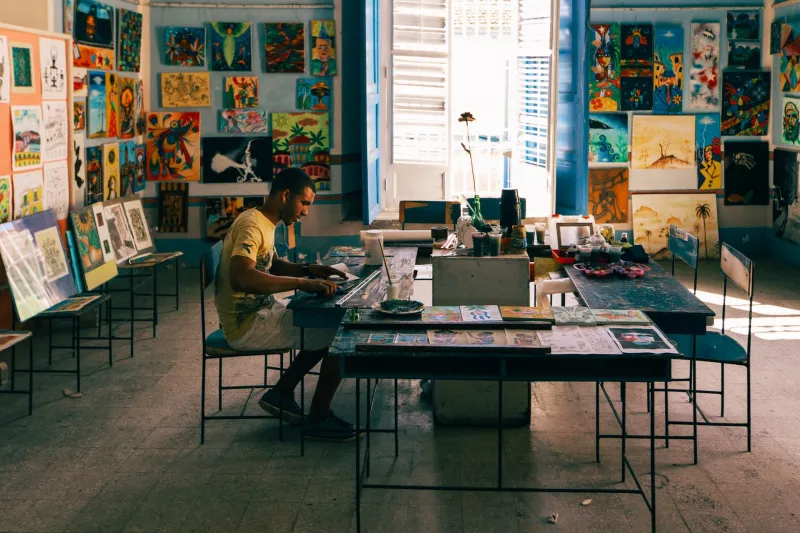
Here's something nobody tells you when you first pick up a brush: the paintings you're most proud of probably won't happen when you're focused, careful, and trying your absolute hardest. They'll happen on a random Tuesday when you're tired, you've already messed up the horizon line, and you figure you've got nothing left to lose.
Welcome to the Paradise Painter's Paradox — the weird, frustrating, ultimately kind of beautiful truth that your best creative work often lives on the other side of giving up on being good.
The Anxiety Trap Nobody Warns You About
Most of us come into painting with some version of the same dream: we want to create something that looks like paradise. Crystal water, golden light, palms swaying in a breeze that you can practically feel. And because we care so much about that vision, we grip the brush tighter. We second-guess every stroke. We paint one square inch, hate it, wipe it off, and paint it again.
Psychologists call this kind of mental overcrowding cognitive interference — basically, your brain is so busy monitoring your performance that it crowds out the creative thinking that actually makes art interesting. You're spending mental energy on judgment instead of imagination. And judgment, as it turns out, is a terrible painter.
Research on creative cognition backs this up. Studies consistently show that people produce more original, expressive work when they're operating in what psychologist Mihaly Csikszentmihalyi famously called a flow state — that absorbed, almost meditative zone where time disappears and the work just... happens. Flow requires a specific condition: the challenge has to feel just slightly beyond your comfort zone, but not so overwhelming that anxiety takes over. The moment you start fixating on whether your painting is "good," you've already knocked yourself out of flow.
What 'Productive Failure' Actually Looks Like
San Diego-based tropical artist Maya Reinholt describes her creative turning point as "the day I ruined a painting I'd been babying for two weeks."
"I'd been so careful with it," she says. "Every brushstroke was deliberate. And it looked... dead. Like a photograph that didn't know it was supposed to be art." In frustration, she grabbed a wide palette knife and dragged it across the whole canvas. "I fully expected to throw it out. But something happened in those drag marks — the colors mixed in ways I never would have planned, and suddenly there was this atmosphere. This feeling of a place."
That painting sold for $1,400 at a gallery show in Encinitas three months later.
What Maya stumbled into is what creativity researchers call productive failure — the idea that mistakes, when you stop treating them as catastrophes, become information. They show you what the painting actually wants to be, rather than what you were forcing it to become.
This isn't a fluke. It's a pattern that shows up again and again among artists who eventually break through to work they're genuinely proud of.
Your Inner Critic Is a Terrible Art Director
Here's the thing about perfectionism: it pretends to be helpful. It tells you it's just trying to make your work better, that it's the reason you have standards. But in practice, perfectionism in painting usually produces one of two outcomes — either work that's technically correct but emotionally flat, or total creative paralysis where you never finish (or start) anything at all.
Neither of those is paradise.
The internal critic is particularly brutal when you're painting tropical or nature-based scenes, because there's this persistent idea that paradise looks a specific way. Turquoise water has to be exactly turquoise. Sunsets have a prescribed color order. Palms lean at approved angles. But real paradise — the kind that makes people stop in front of a painting and feel something — doesn't come from following a visual rulebook. It comes from the emotional truth behind the image.
And emotional truth, weirdly, tends to emerge when you're not watching for it.
Practical Ways to Get Out of Your Own Way
So how do you actually access this less-trying, more-creating state? A few approaches that working artists swear by:
Set a timer and don't stop. Give yourself 20 minutes on a small canvas — 6x6 or 8x8 — and commit to not lifting the brush or stopping to evaluate. Keep moving. The goal isn't a finished piece; it's to outpace your inner critic. You'll be surprised what appears when judgment can't keep up.
Paint with your non-dominant hand. It sounds silly, but using your off hand forces your brain into a different gear. You can't be precious when you're fighting basic motor control. Many artists find that non-dominant hand studies have a looseness and energy their "real" work lacks — and they start chasing that quality back into their main practice.
Use materials that fight back. Watercolor on wet paper. Ink. A wide, cheap brush that doesn't give you fine control. When the tool won't let you be precise, you stop trying to be precise, and something more interesting tends to take over.
Give yourself a bad painting quota. Literally tell yourself: I'm going to make five bad paintings this week. Take the pressure off any single piece being "the one." When you're not emotionally invested in any one canvas surviving, you take risks. And risks are where breakthroughs live.
The Composition Paradox
Here's one more thing that surprises people: when you stop obsessing over technical correctness, your composition often improves. Not because you've stopped caring about it, but because you've freed up the intuitive part of your brain that actually understands visual balance.
Your eye knows more than your analytical mind does. Years of looking at images — paintings, photographs, movies, the actual world — have given you an instinctive sense of what feels right in a frame. When you're locked in perfectionist mode, you override that instinct with rules. When you let go, the instinct gets a say. And instinct, in painting, is usually smarter.
The same goes for color. Artists who loosen up frequently report that their color mixing becomes more adventurous and, paradoxically, more accurate — not to what a tropical scene technically looks like, but to how it feels. That's the distinction between a postcard and a painting that takes your breath away.
The Permission You've Been Waiting For
If there's one thing this community at Paint Me Paradise is built on, it's the belief that paradise isn't just a place you visit — it's something you create. And creation, real creation, is inherently messy and uncertain and alive.
You don't have to earn your way to good paintings by being perfect first. The path actually runs the other direction. Make the bad ones. Drag a palette knife through something you've been babying. Set the timer and don't stop. Let the brush go somewhere you didn't plan.
Paradise, as it turns out, tends to show up right around the moment you stop trying to control exactly where it lands.