You Got Better at Painting Paradise — So Why Does It Feel So Empty?
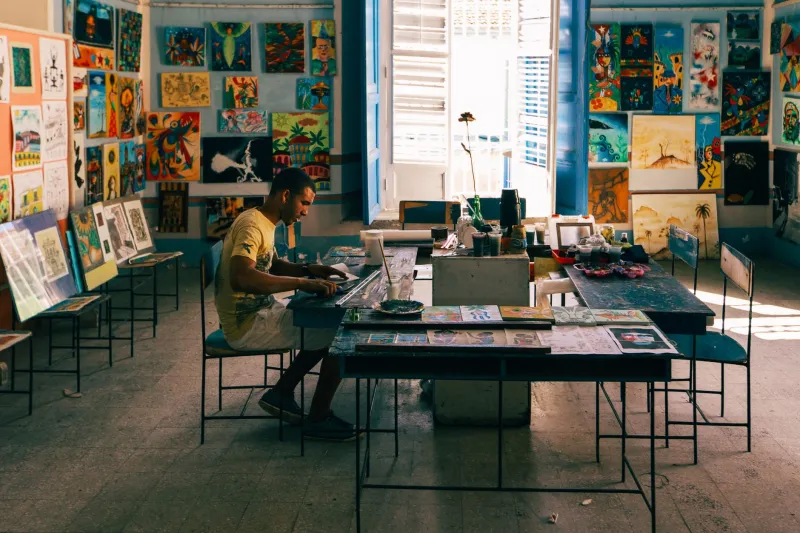
There's a moment a lot of intermediate painters recognize the second you describe it to them. You set up your canvas, squeeze out your paints, and look at the reference photo of that gorgeous Bahamian shoreline. You know exactly what to do. You've done it a hundred times. Your hand moves with confidence. And somewhere around the halfway point, a quiet, uncomfortable thought creeps in:
This feels like nothing.
Not bad. Not good. Just... nothing.
If you've been painting paradise scenes for a couple of years, you've probably hit this wall. Your work looks objectively better than it did when you started. Your friends notice. Maybe you've even sold a piece or two. But the electric feeling you had when you first mixed a turquoise that actually glowed? Gone. The giddiness of watching a palm tree take shape out of nowhere? Faded. What used to feel like a mini-vacation every time you picked up a brush now feels like filling out paperwork.
This is the paradise painting trap — and it catches almost every serious artist eventually.
Why Getting Good Can Quietly Wreck Your Joy
Here's the psychological reality: when you were a beginner, every session was an adventure because you genuinely didn't know what would happen. Would the waves look like waves? Would the sand read as warm or muddy? The uncertainty was uncomfortable, sure, but it was also alive. Your brain was fully engaged, problem-solving in real time, releasing little hits of dopamine every time something clicked.
As your skills improved, that uncertainty shrank. And with it, so did the neurological reward.
Research on skill acquisition backs this up. The brain's reward centers fire most intensely during the learning phase — when challenge and ability are roughly matched. Once ability starts to outpace challenge, the task shifts from stimulating to routine. You're no longer discovering; you're executing. And execution, however polished, doesn't light up the brain the same way discovery does.
For paradise painters specifically, this gets compounded by something else: the subject matter itself. Tropical scenes are inherently soothing. That's a feature, not a bug. But soothing and exciting aren't the same thing. If you came to paradise painting because it felt like an escape, and now it just feels like a task you're competent at, you've lost the very thing that brought you here.
The Comparison Spiral That Makes Everything Worse
Layer on top of that the very American habit of measuring progress against other people's highlight reels, and you've got a recipe for creative deflation. Social media feeds full of stunning tropical artwork can shift your internal motivation from I want to feel something to I want to produce something impressive. Those are wildly different goals, and only one of them tends to produce joy.
When your paintings become evidence of your skill level rather than expressions of your experience, the whole enterprise starts to feel transactional. You're no longer painting to explore — you're painting to perform. And performing is exhausting, even when you're good at it.
What Artists Who Stay Joyful Actually Do Differently
The painters who seem to maintain genuine enthusiasm for their work over the long haul aren't the ones who stopped caring about technique. They just stopped letting technique be the whole point.
A few things they tend to have in common:
They deliberately introduce friction. Not random chaos, but intentional constraints that force them out of autopilot. Painting with their non-dominant hand. Using only three colors. Working much larger or much smaller than usual. Giving themselves thirty minutes instead of three hours. The goal isn't to produce a great painting — it's to reactivate the part of the brain that has to actually think.
They separate practice sessions from play sessions. Deliberate practice — the kind that builds technical skill — is supposed to feel like work. It's focused, repetitive, and mentally taxing. But not every painting session needs to be that. Keeping a separate sketchbook or small canvas purely for messing around, with zero intention of producing anything shareable, protects a creative space where joy can actually live.
They reconnect with the original feeling, not just the subject. Ask yourself: what did paradise mean to you when you first started painting it? Was it the memory of a specific trip? A color that made you feel calm? A sense of space and light that your actual environment lacked? That original emotional anchor is the real subject of your work — not the palm tree or the shoreline. Finding ways to paint toward that feeling, rather than toward a technically accurate representation of it, tends to reopen the emotional channel.
They let some paintings be bad on purpose. This one sounds counterintuitive, but hear it out. When every session carries the weight of your current skill level — when you feel like you should be producing work that reflects how far you've come — the stakes feel too high to play. Giving yourself explicit permission to paint something genuinely terrible, just to see what happens, removes that pressure and often produces unexpected results.
The Paradox at the Heart of It
Here's the thing nobody warns you about when you start improving: skill gives you more control, but joy often lives in the places where control breaks down a little. The happy accident. The color that mixed wrong and somehow looked right. The background you rushed and ended up loving more than the focal point you labored over.
Technique is supposed to serve your vision, not replace it. When your brushwork becomes so reliable that it runs on autopilot, it can actually get in the way of the kind of presence that makes painting feel meaningful.
The fix isn't to stop developing your skills. It's to keep asking yourself what you're actually trying to feel when you paint — and then building sessions around chasing that feeling, not just executing the technique.
Paradise, after all, isn't a color palette or a set of compositional rules. It's a state of mind. And no amount of technical mastery will get you there if you've stopped showing up to actually experience the journey.
So the next time you sit down with a blank canvas and a beautiful reference, try this: put the reference away for the first ten minutes and just paint what paradise feels like today. Not what it looks like. What it feels like.
Your technique will still be there when you need it. But you might be surprised what shows up when you let it take a back seat for a while.