The Secret Behind Every Breakthrough: Why Painting Without Caring Unlocks Your Best Paradise Work
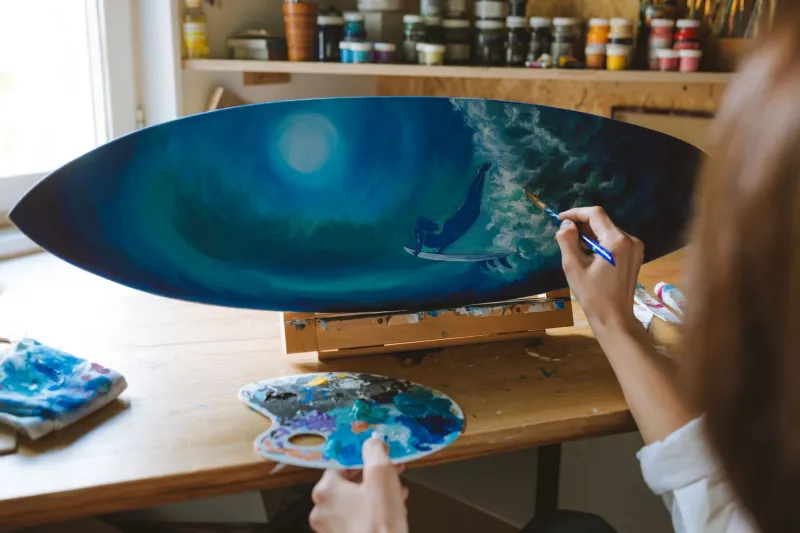
You know the painting. It's the one hanging slightly crooked on your studio wall, the one you almost scraped down mid-session because nothing felt like it was working. The water looked wrong, the palm fronds were too stiff, the whole thing seemed like a disaster in progress. And then — somehow — it became the piece everyone stops in front of.
That's not a coincidence. That's psychology doing something genuinely wild to your creative process.
There's a phenomenon that paradise painters talk about in hushed, slightly embarrassed tones: the work that lands hardest is almost never the work you were white-knuckling through. The masterpieces don't usually show up when you're hunched over the canvas trying to prove something. They show up when you've basically given up caring — at least for a little while.
So what's actually going on when that happens?
The Science of Not Trying (And Why It Works)
Psychologist Mihaly Csikszentmihalyi spent decades studying what he called "flow" — that mental state where you're so absorbed in an activity that time dissolves and self-awareness drops out of the picture. Athletes talk about being "in the zone." Musicians describe it as the moment the song starts playing itself. Painters? They usually describe it as the session they almost didn't show up for.
Flow states are neurologically interesting because they're associated with what researchers call "transient hypofrontality" — a temporary quieting of the prefrontal cortex, which is the part of your brain doing all the second-guessing. That inner critic who keeps whispering that your horizon line is off, that the turquoise isn't quite right, that other artists are better than you? That voice lives in the prefrontal cortex. And when flow kicks in, it gets turned way down.
What's left is pure process. Brush hits canvas. Color responds to color. Your hand starts making decisions your conscious mind wasn't even part of.
For paradise painters specifically, this matters in a unique way. Tropical and coastal scenes are loaded with visual complexity — layered light on water, the chaos of foliage, the way a sunset refuses to stay still long enough to be captured. When you're overthinking, that complexity becomes a source of anxiety. When you're in flow, it becomes a playground.
Self-Consciousness Is the Real Enemy
Here's an uncomfortable truth about the artistic perfectionism most of us drag into the studio: it's not actually about quality. It's about fear of judgment — your own judgment, mostly.
When you sit down to paint a beach scene with the goal of making it good, you've already introduced an audience into the room. That imaginary audience watches every brushstroke. It compares your work to the reference photo, to the artist you follow on Instagram, to the piece you made six months ago that you actually liked. It keeps score.
That audience is the problem.
Self-consciousness creates what psychologists call an "evaluative threat" — the brain perceives the possibility of failure as something worth defending against. And defending against failure looks a lot like hesitation, overworking, second-guessing, and eventually, painting something technically correct but emotionally hollow.
Paradise art is supposed to feel like something. A turquoise cove should carry the sensation of stepping out of the Florida heat into cool water. A hammock strung between palms should make your shoulders drop. When self-consciousness runs the session, you get the postcard version. When it gets out of the way, you get the real thing.
Practical Ways to Trick Yourself Into the Good Stuff
The tricky part is that you can't just decide to stop caring. Telling yourself "don't overthink it" is like telling someone not to think about a pink elephant — immediately counterproductive. What you can do is engineer the conditions that make overthinking harder.
Set a timer and paint ugly on purpose. Give yourself fifteen minutes to make the worst tropical scene you possibly can. Wrong colors, sloppy edges, total disregard for composition. What happens almost universally is that somewhere in the mess, something interesting appears. Your hand was moving freely, your critic was standing down, and your instincts snuck in through the back door.
Change your stated goal. Instead of sitting down to "paint a good beach scene," tell yourself you're just experimenting with how cerulean behaves next to raw sienna. You're not making art — you're just watching paint do stuff. This sounds silly, but it genuinely shifts the stakes and lets your prefrontal cortex relax its grip.
Use your non-dominant hand for the first ten minutes. It sounds gimmicky until you try it. Painting with your off hand is so awkward that your brain stops evaluating and starts just trying to manage the chaos. By the time you switch back, you're warmed up and loose in a way that deliberate warm-up exercises rarely produce.
Create a "throwaway" canvas ritual. Keep a dedicated piece of cheap canvas or heavy paper that you'll never show anyone and never keep. Use it at the start of every session to dump whatever's in your head — messy, fast, zero stakes. Think of it as clearing your browser history before you open the real work.
Listen to something that hijacks your attention. A podcast, an audiobook, a playlist with lyrics you know every word to. When part of your brain is occupied with language processing, there's less bandwidth left for the inner critic to run its commentary. Some of the most interesting textural choices and color combinations happen when the painter's conscious mind is literally somewhere else.
The Paradox You Have to Make Peace With
Here's the part that frustrates a lot of painters when they first hear it: you can't manufacture this state on demand. You can't schedule a flow session the same way you'd schedule a dentist appointment. The conditions you create are invitations, not guarantees.
But here's what you can do — you can stop actively blocking it. Most of us aren't failing to reach flow because we lack talent or technique. We're failing to reach it because we keep showing up to the canvas with a predetermined idea of what "good" looks like, and then punishing ourselves in real time when the paint doesn't cooperate.
The paradise you're trying to paint isn't just a place. It's a state. And the strange, slightly maddening truth is that your best work lives in the same mental space as actual rest — that loose, unhurried, slightly dreamy mode where you're present without being pressured.
The painters who figure this out don't stop caring about their craft. They care deeply. But they've learned to care about the process rather than the outcome — at least while the brush is moving. The judgment, the editing, the critical eye — all of that has its place. It's just not during the session.
Show up. Mix some color. Let the canvas be a place you're visiting rather than a test you're taking.
Paradise has a way of appearing when you stop demanding it.